
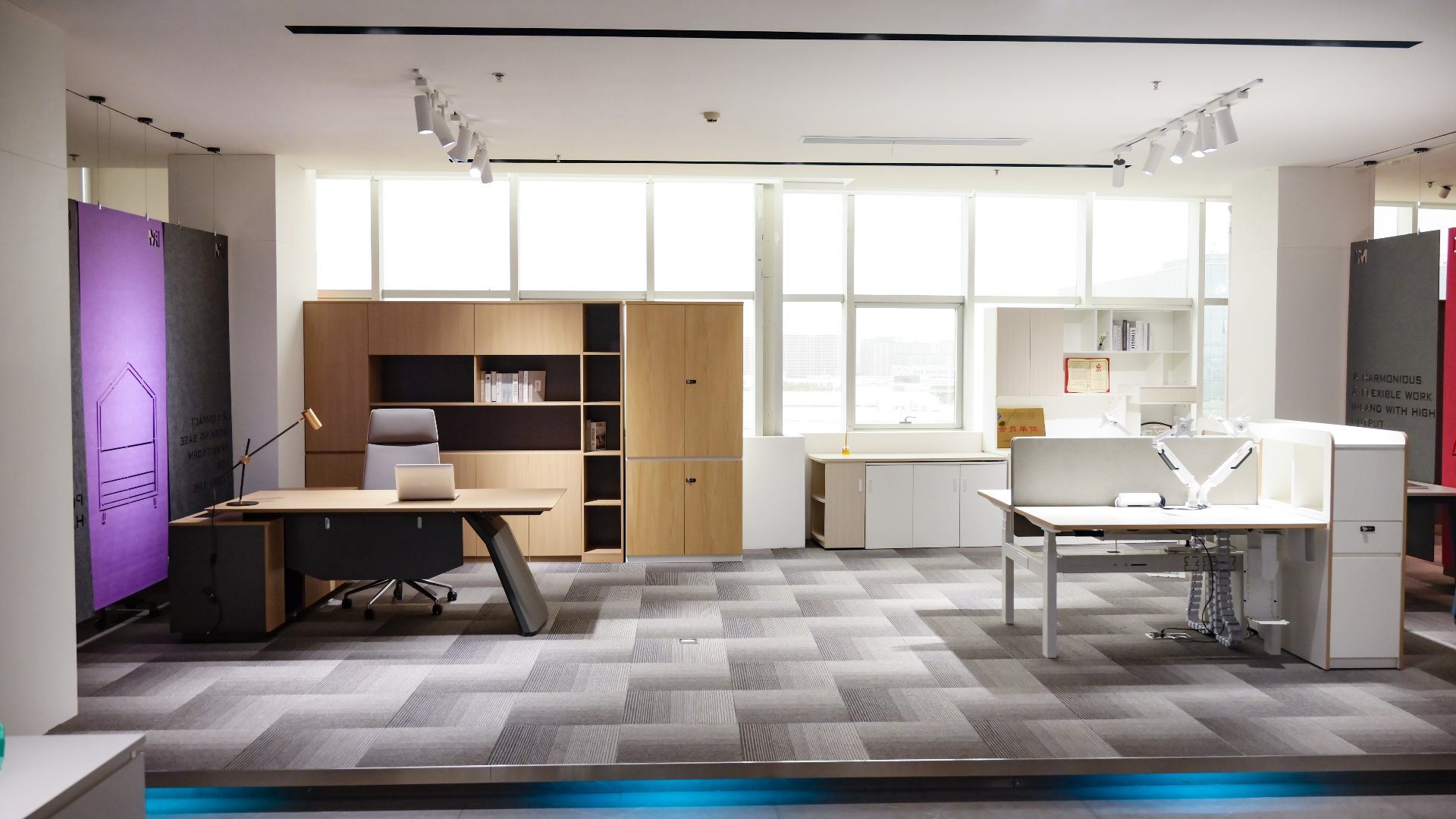
Hybrid work was an emergency measure a few years ago. By 2026 it has become routine for many companies in Shanghai. Over the past two years, more organisations replanning their offices have taken the same step: reduce the number of fixed workstations and expand space for meetings, informal discussion and focused work.
When the space mix changes, furniture is the first thing to be redone. The old pattern of one desk, one chair and one cabinet per person is being replaced by sit-stand desks, modular screen workstations and movable storage. For companies preparing a new office or renovating an existing one, understanding three trends is more valuable than comparing prices alone.
01 Workstations are no longer one person, one seat
With hybrid work, attendance is the first number to reconsider. At companies where staff are on site two to three days a week, daily occupancy generally sits between 60 and 70 percent, leaving a significant share of assigned desks empty much of the time.
This changes the logic of space planning from assigning desks to people to supporting different scenarios. Organisations need settings that can switch: fixed positions for long periods of desk work, shared desks for temporary use, discussion spaces with doors, and small enclosed spaces for quiet calls.
Furniture requirements change accordingly: adjustable desk heights for users of different stature; lockable storage so shared desks do not disturb one another; and castors or lightweight construction so positions can follow team changes. In an office area of around 300 square metres, a reconfigured plan can typically raise the number of usable workstations by more than 20 percent.
02 Sit-stand desks move from benefit to standard
The second clear change is the spread of sit-stand desks. A few years ago they were a benefit for management or selected staff. Now more companies include them in standard purchasing, especially for research and development, design and customer service roles that involve long hours at a desk and frequent standing discussions.
Several parameters matter more than appearance when choosing electric sit-stand desks. Twin motors are steadier than a single motor and reduce movement during adjustment. Load capacity should cover dual monitors plus a tower unit. Low lifting noise matters in an open office where dozens of desks move at once. Memory height settings appear minor but are used frequently.
One often overlooked point: a sit-stand desk is not simply placed and used. When the top rises, monitor, power and network cables move with it. Without planned cable channels and floor sockets, the result is a tangle of wires. Sit-stand desks therefore work best as part of an overall space plan rather than as isolated purchases.
03 Modular furniture keeps space adaptable
The third trend is modularity. Organisations restructure every three to five years: departments merge, new teams form. With traditional hard partitions and fixed-size furniture, every change means demolition and new purchases, costing both money and time.
Modular systems are built for reconfiguration. Screen systems can gain or lose sections, meeting tables can be joined or split, storage units can be stacked or moved, and cabling can be resolved within the system. Adjustments require no construction work and no full replacement, reducing both cost and downtime.
In hybrid settings, small independent spaces such as acoustic pods and phone booths are also worth attention. When meeting rooms are insufficient and calls should not disturb colleagues, they are the lowest-cost solution.
04 From buying furniture to buying a solution
The three trends point to one conclusion: what organisations need is not a batch of furniture but a space plan that can be delivered. Furniture-only purchasing most often creates three problems: dimensions that do not fit the site, discovered only at installation; circulation and functions that remain cramped after completion; and multiple suppliers delivering in stages and delaying one another. None is solved by buying more expensive furniture.
A more reliable approach is to handle measurement, space planning, product configuration, production, installation and after-sales in one chain. PUMEI Furniture has worked in commercial offices for 22 years and has taken part in more than 2,000 office and public space projects, covering executive offices, meeting rooms, staff workstations as well as education, healthcare, senior living, hotel and apartment scenarios.
05 Local conditions in Shanghai
Shanghai has many older office buildings. The first checks are usually not about style but about physical constraints: floor load, ceiling height, whether lift cars can take large panels, whether fire corridors meet partition requirements and whether power and data points are sufficient. Confirming these at drawing stage avoids substantial rework later.
Delivery rhythm matters as well. A full-floor renovation usually proceeds in phases, starting with the core office area and then meeting and shared areas. Furniture production must align with construction progress, or the site will be ready before the furniture arrives, or furniture will arrive before the site is cleared.
Frequently asked questions
How many workstations should be planned after moving to hybrid work?
A common approach is to provide fixed desks at 1.1 to 1.2 times peak attendance, with an additional 10 to 15 percent of shared desks and discussion spaces. Attendance patterns differ by department, with field sales and research teams behaving very differently, so estimates are best made department by department rather than by a single company-wide ratio.
Are sit-stand desks worth equipping across the whole company?
Not necessarily across every role. Prioritise positions with long desk hours and frequent standing discussions; other roles can start with fixed-height desks and ergonomic chairs and add sit-stand desks later. With a limited budget, stability, load capacity and cable management matter more than extra features.
Does modular furniture cost more to change later?
Initial unit prices are usually slightly higher than standard furniture, but total cost over three to five years is often lower once adjustments are counted. Changing traditional fixed furniture nearly means buying again, while modular systems only add or remove components, making dismantling and transport much cheaper.
How should a Shanghai office furniture factory be selected?
Check three things: whether the supplier can provide a space plan and configuration list, not only a quotation; whether comparable completed sites can be visited; and whether delivery and after-sales are handled by the same team. These three points are more informative than showroom size.
This article is published by PUMEI Furniture for procurement and project reference. Project data and specifications are subject to written confirmation before contract signing.